Parcours Explorations architecturales
Duration: 1h30

Jean Nouvel designed the Fondation Cartier’s first Paris building, on Boulevard Raspail, and the collaboration has continued with the new building at 2 Place du Palais Royal. This trail sheds light on Nouvel’s architectural project, and introduces visitors to a selection of works from the Machines d’architecture section of Exposition Générale.
Part 1: 2 Place du Palais Royal: building history
The trail begins with a look the building’s exterior, a walk under the arcades, and entry via the Place du Palais Royal.
The building’s history is rooted in the transformation of the surrounding Louvre district in the 19th century, under the impetus of Baron Hausmann. It was constructed to accommodate visitors to Paris on the occasion of the Exposition Universelle of 1855, and was known as the Grand Hôtel du Louvre. Gradually, the hotel – which housed boutiques on its ground level from the time of its opening – was transformed into a commercial space: in 1887, it became the Grands Magasins du Louvre, proposing a wealth of items of all types, and regular exhibitions of new products. In the 1970s, the building was once again transformed: it became the Louvre des Antiquaires, which held 240 shops, and closed in 2019.
The Fondation Cartier’s new architectural project was entrusted to Jean Nouvel. He stripped down the building, removing the interior modifications made by its various occupants – particularly, the numerous walls dividing the shops of the Louvre des Antiquaires. Today, the building’s many incarnations have vanished, leaving only the original exterior facades from the time of the building’s construction, which encompass the famous arcades along the Rue de Rivoli and on the Place du Palais Royal.
-

Discover the history of this iconic building
Welcome to the Fondation Cartier pour l’art contemporain, located in the heart of Paris in an emblematic building emblematic. Discover its history through augmented reality.
Discover
Part 2: Flow of the gaze and transparency
The flow of the gaze in the building is a major aspect of the project. The possibility of scanning the space from one side of the building to the other, and from top to bottom, creates vast, intelligible volumes. For Nouvel, “Everything that can be removed, must be removed, besides the essential load-bearing walls. The gaze must cross over something in which there is nothing.”
Transparency contributes a great deal to the flow of the gaze. It begins from the building’s exterior: large picture windows create the appearance of a building without walls, providing a view of the works presented inside, as though the exhibition space flowed out into the city or vice-versa. The addition of three glass ceilings heightens this sense of flow from outside to inside. The opposite sensation exists as well: from the inside, the city, passers-by, and changes in light circulate freely, and also seem to dwell within the building.
Another addition by Nouvel is a glass awning on the Rue Saint-Honoré side, which reinforces the singular urban unity and brings together the experiences of the street, the historical arcades, and the interior spaces.
-

La Fondation Cartier pour l'art contemporain, 2, place du Palais-Royal, Paris © Martin Argyroglo -

La Fondation Cartier pour l'art contemporain, 2, place du Palais-Royal, Paris © Danica O Kus -

La Fondation Cartier pour l'art contemporain, 2, place du Palais-Royal, Paris © Danica O Kus -

La Fondation Cartier pour l'art contemporain, 2, place du Palais-Royal, Paris © Danica O Kus
Part 3: Machinery at the service of a novel experience
Another crucial element of the architectural project is the building’s modularity. In this immense space, the traces of the Hausmannian past are apparent alongside the newly implanted industrial machinery – five steel platforms with visible mechanisms for moving them. These platforms might serve as floors or ceilings, and each one can be raised or lowered on its vertical axis, modifying the exhibition space and the level of light.
Through this dynamic architecture, the spaces can be freed or filled; the depth of visibility can be expanded or contracted; and a multitude of viewpoints on the works are possible. It reinvents how exhibitions are designed, with infinite options for the artists and a wholly novel experience for visitors.
-

Dynamic architecture for exhibition making
Discover three different configurations of this open, modular building via augmented reality. Five platforms allow countless configurations of the spaces, asserting architecture’s role in the engineering of exhibitions.
Discover
Part 4: Architectural experimentations in Exposition Générale
In this optimal showcase for displaying all forms of contemporary creation, the inaugural exhibition features a large portion of the works from the Fondation Cartier’s collection. Divided into four sections, the one titled Machines d’architecture proposes an exploration of the alternative visions of the artists and architects shown in it.
A single platform encompasses the maquette of a utopian project for Kinshasa by Bodys Isek Kingelez; Alessandro Mendini’s surprising, colorful Petite cathédrale, from which scents and sounds emanate; and a part of a project for a monumental chapel by the Japanese architect Junya Ishigami. Further along on the trail, Mamadou Cissé’s lively, detailed drawings of cities can be seen, as can a kitsch replica of a ballroom by Freddy Mamani, the Bolivian architect who has transformed his city of El Alto with his colorful geometric architecture.
The trail is scattered with other architectural experimentations, offering a fresh gaze on this practice and its transformative power.

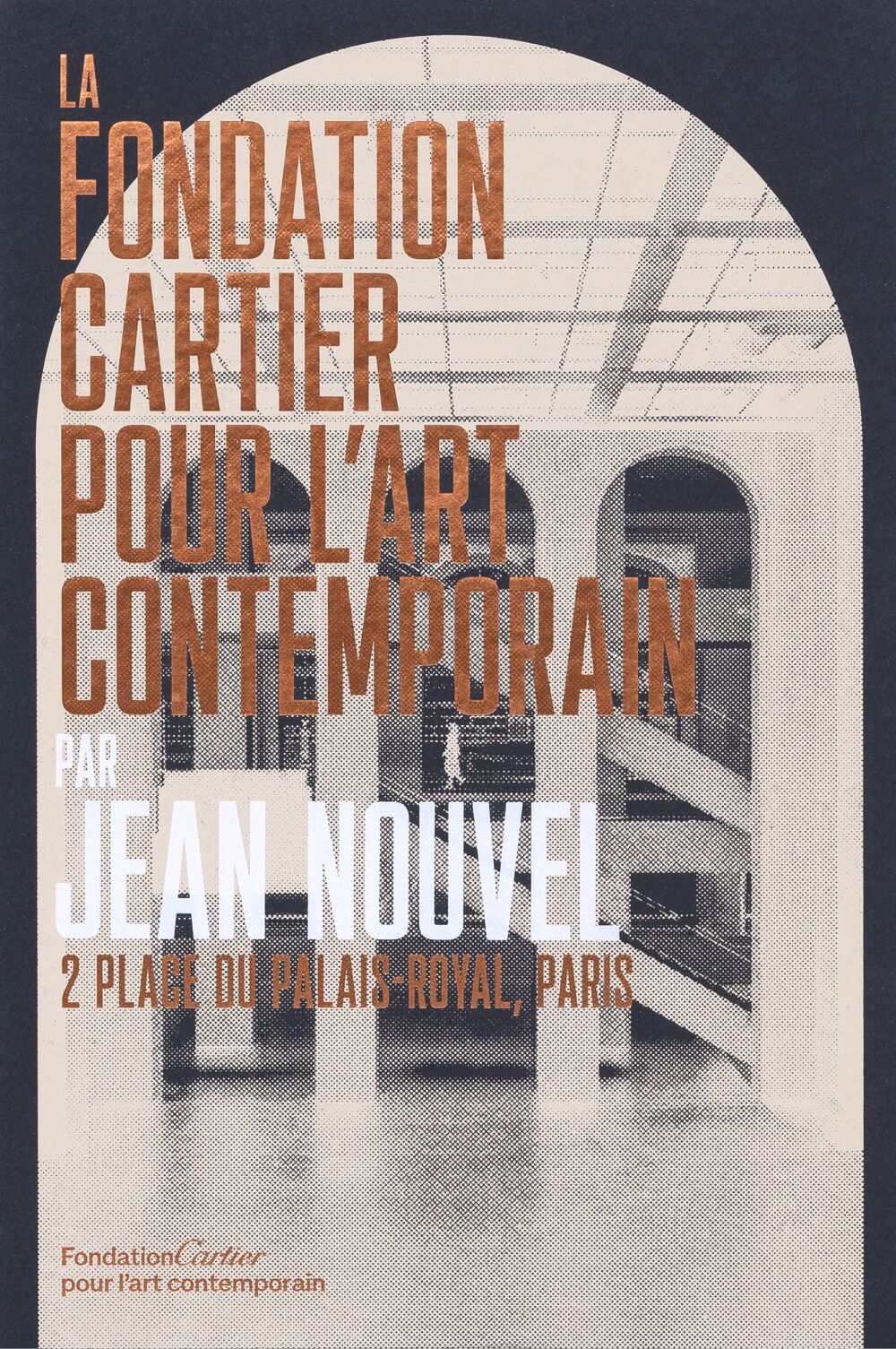
The Fondation Cartier pour l’art contemporain by Jean Nouvel
2, place du Palais-Royal, Paris
Events
-

- Paris
- Sat 25 Oct 2025 → Sun 23 Aug 2026
- Fondation Cartier pour l’art contemporain
-

- Paris
- 25 Oct 2025 → 23 Aug 2026, every Saturday + Sunday, multiple times available
- Fondation Cartier pour l’art contemporain
-

- Paris
La visite insolite
"Être Nature" thematic
- Tue 28 Oct 2025, 19:00
- Fondation Cartier pour l’art contemporain
Change language
- English
- Français
- Arabic أهلًا بك في مؤسّسة Fondation Cartier pour l’art contemporain
- Deutsch Willkommen bei der Fondation Cartier pour l’art contemporain
- Español Bienvenida a la Fondation Cartier pour l’art contemporain
- Italiano Ti diamo il benvenuto alla Fondation Cartier pour l’art contemporain
- Japanese Fondation Cartier pour l’art contemporain へようこそ
- Chinese 欢迎来到Fondation Cartier pour l’art contemporain
- Korean Fondation Cartier pour l’art contemporain에 오신 것을 환영합니다