Fondation Cartier and architecture

In October 2025, the Fondation Cartier pour l’art contemporain leaves behind its premises at 261 Boulevard Raspail to move into 2 Place du Palais-Royal, opposite the Louvre, in a historic building whose interior volumes have been radically redesigned by Jean Nouvel. This new site carries forward the mission of the Fondation Cartier by offering an open, modular space, designed to house contemporary creation whilst preserving the building’s architectural and urban traditions.


2, Place du Palais Royal: a building destined to exhibit
The building of the Fondation Cartier first appeared on Paris maps as a result of the extension of Rue de Rivoli, during the first phase of the major public works conducted by Baron Haussmann. Built in 1854-1855 during the expansion of Rue de Rivoli, at the time of Paris’s first Universal Exposition, the building respects the disposition of the architects Charles Percier and Pierre Fontaine with its uniform stone façade resting on a row of arcades. Five storeys high, the building was home to the Grand Hôtel du Louvre and the Grands Magasins du Louvre, which remained there for almost a century, shaping the cultural and social life of central Paris. With his transformation, Jean Nouvel is showcasing the existing architectural urban elements that are synonymous with the historical modernity of the 19th century.
In December 2013, the Fondation Cartier entrusted the architect with the mission of redesigning the site in order to create a new space for contemporary art. “We need to gain in space from above, below, and in the transversalities of the building. In short, we need to expand the space”, he immediately stated. From this reflection the idea of a giant internal “machine” merged, with vast platforms that could rise and fall beneath the glass ceilings covering the mezzanine. Installing this unprecedented setup inside a heritage building that had already undergone various modifications proved to be quite the challenge.
The building, with four access points, offers a space of 8,500 square metres that is open to the public, of which 6,500 square metres represents exhibition space, spread across the basement, ground floor and the first floor, based on a modular architecture in which different eras are brought face to face.
-

Discover the history of this iconic building
Welcome to the Fondation Cartier pour l’art contemporain, located in the heart of Paris in an emblematic building emblematic. Discover its history through augmented reality.
Discover
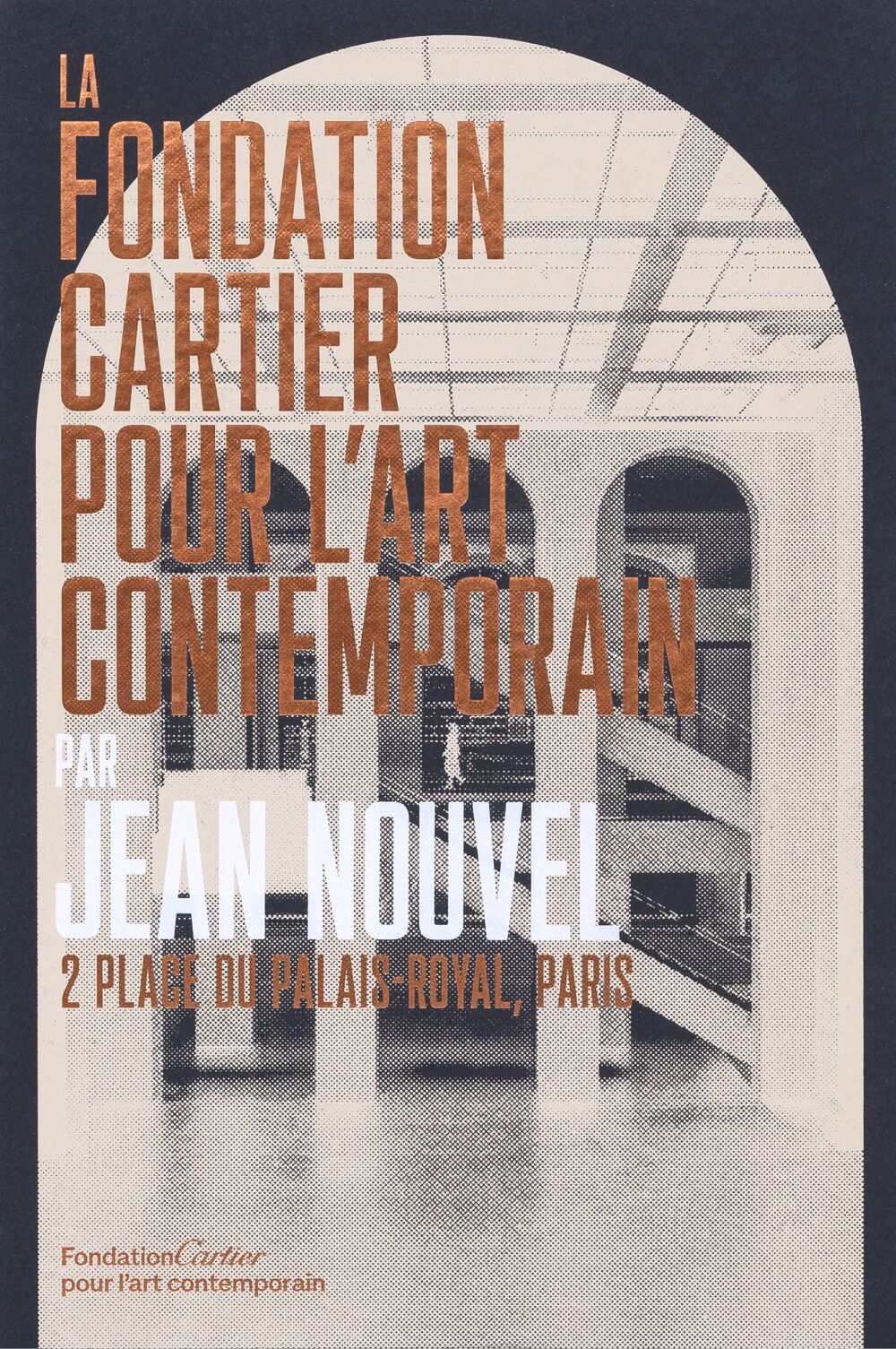
The Fondation Cartier pour l’art contemporain by Jean Nouvel
2, place du Palais-Royal, Paris

The museum as an engine of innovation
Five platforms, each measuring between 200 and 340 square metres, which can be adjusted to different heights, make up museographic device inserted at the center of Fondation Cartier’s building. Behind its fully preserved façade, this dynamic architecture creates an unexpected combination of volumes, voids and spaces, thus reaffirming the modularity of the cultural institution, and the centre stage afforded to innovation in exhibition making by the Fondation Cartier’s project.
The interior architectural landscape makes for an impressive sight: retractable ceilings and mechanical guardrails transform the light and perspectives, offering an ever-changing experience.
With this transformation, Jean Nouvel brings out the architectural and urban elements of the 19th century, with the addition of tall bay windows that run all the way along the façades. The transparency reinterprets the display windows of the past, offering passers-by a complete visual experience. The addition of a glass canopy, reminiscent of those that once featured on Rue de Saint-Honoré and Rue de Marengo, reinforces this unique urban unity and merges the experiences of the street, the historic arcades and the interior spaces.
-

Dynamic architecture for exhibition making
Discover three different configurations of this open, modular building via augmented reality. Five platforms allow countless configurations of the spaces, asserting architecture’s role in the engineering of exhibitions.
Discover

Fondation Cartier pour l’art contemporain POP UP
“The Fondation Cartier will most likely be the institution offering the greatest differentiation of its spaces, the most diverse exhibition forms and viewpoints. […] According to the selected configuration, these spaces of variable geometries will be invented and discovered as the different projects unfold.”
Jean Nouvel
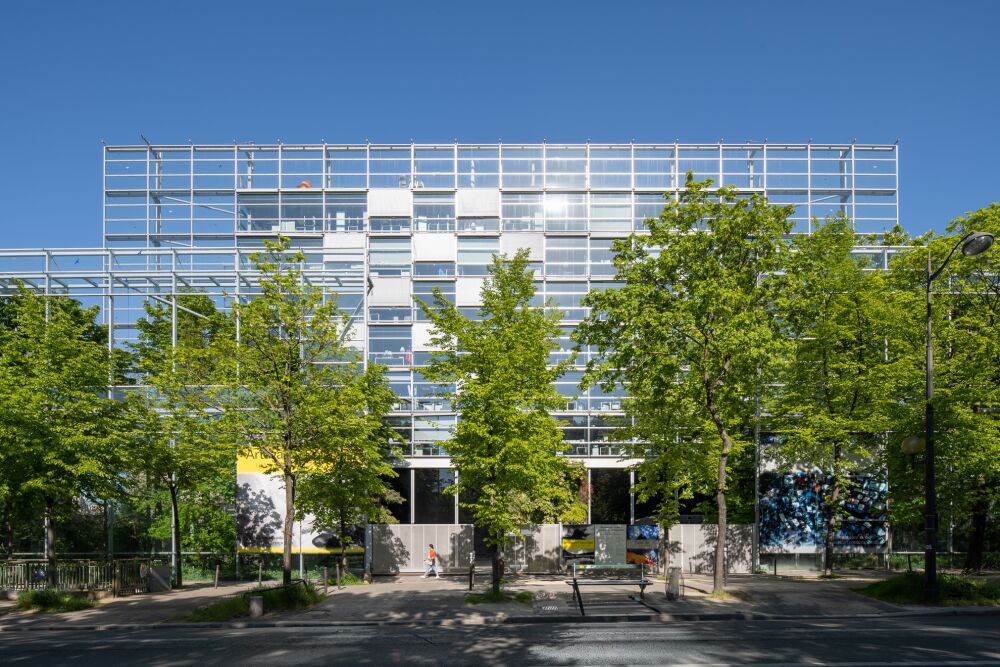
Architecture has influenced the Fondation Cartier’s programming ever since its beginnings. In 1994,the Fondation Cartier pour l’art contemporain left the Domaine du Montcel in Jouy-en-Josas and moved to Paris, at 261 Boulevard Raspail, in a glass and steel building designed by Jean Nouvel. This open site broke with the “white cube” aesthetic in favour of dynamic materials that opened out both onto the garden and the city. Making its mark on contemporary urbanism, this building, full of reflections – eight floors of glass and steel – plays with the variations in light, offering an unprecedented context to artists invited to exhibit there.
This building open out onto its garden, the Theatrum Botanicum, designed by German artist Lothar Baumgarten, broke down the barriers between inside and outside. “Everything is in motion, reflected in the interplay of horizontal and vertical rhythms, and the changing of seasons.”, commented the artist at the inauguration of its garden.
“The architecture is lightness itself, with its windows and delicate steel structure. An architecture that purposely plays with blurring the building’s tangible limits making any notion of a solid volume superfluous, in a poetics of indistinctness and evanescence.”
Jean Nouvel on the Fondation Cartier, 261 Boulevard Raspail
-
-

© Martin Argyroglo

Jean Nouvel
Architecte
Jean Nouvel’s approach, guided by the urban context and history of sites, as well as the present time, has made him an internationally renowned architect. He accomplished his first major project between 1981 and 1987 in Paris: The Arab World Institute was built on the Left Bank of the River Seine. Since then, he has gone on to design a large number of cultural buildings and spaces across Europe and throughout the world. In Paris and its surrounding areas, he created the Fondation Cartier pour l’art contemporain on Boulevard Raspail (1994), the Musée du Quai Branly – Jacques Chirac (2006), the Philharmonie de Paris (2015) and more recently the Hekla Tower, as well at the Tours Duo (2022).
The extension to the Museo Nacional Centro de Arte Reina Sofía in Madrid and Agbar tower in Barcelona (2005), the two plant-covered towers of One Central Park in Sydney (2014) – designed in collaboration with botanist and artist Patrick Blanc –, the Louvre Abu Dhabi museum (2017), the National Museum of Qatar in Doha (2019), the 53W53 glass tower that overlooks the MoMA in New York (2019) as well as the Museum of Art Pudong in Shanghai (2021) are all international projects designed by Jean Nouvel which play a role in pushing the boundaries of contemporary architecture.
Discover the Fondation
Change language
- English
- Français
- العربي أهلًا بك في مؤسّسة Fondation Cartier pour l’art contemporain
- Deutsch Willkommen bei der Fondation Cartier pour l’art contemporain
- Español Bienvenida a la Fondation Cartier pour l’art contemporain
- Italiano Ti diamo il benvenuto alla Fondation Cartier pour l’art contemporain
- 日本語 Fondation Cartier pour l’art contemporain へようこそ
- 中文 欢迎来到Fondation Cartier pour l’art contemporain
- 한국어 Fondation Cartier pour l’art contemporain에 오신 것을 환영합니다