Ibrahim Mahama
The Harvest Season
- Exhibition, Paris
- Thu 22 Oct 2026 → Sun 28 Feb 2027

In fall 2026, the Fondation Cartier pour l’art contemporain is proud to present The Harvest Season, an exhibition on an unprecedented scale in France of Ghanaian artist Ibrahim Mahama, accompanied by nine associate artists and collectives: Dorothy Akpene Amenuke, Gideon Appah, James Barnor, the Cercle d’Art des Travailleurs de Plantation Congolaise (CATPC), Courage Dzidula Kpodo, Zohra Opoku, Postbox Ghana, Tjaša Rener and Feda Wardak.
“It is in the past that we can excavate the potential of the future. The future isn’t something that just ‘exists’ somewhere, it also lives in our past memories, in the form of unrealized futures.”
Ibrahim Mahama
For the Fondation Cartier, Ibrahim Mahama has imagined a living entity in resonance with the art centers he has founded in Tamale, northern Ghana. With the associate artists, he occupies all of the Fondation Cartier’s new space, with site-specific works, along with new versions of a selection of his iconic installations.
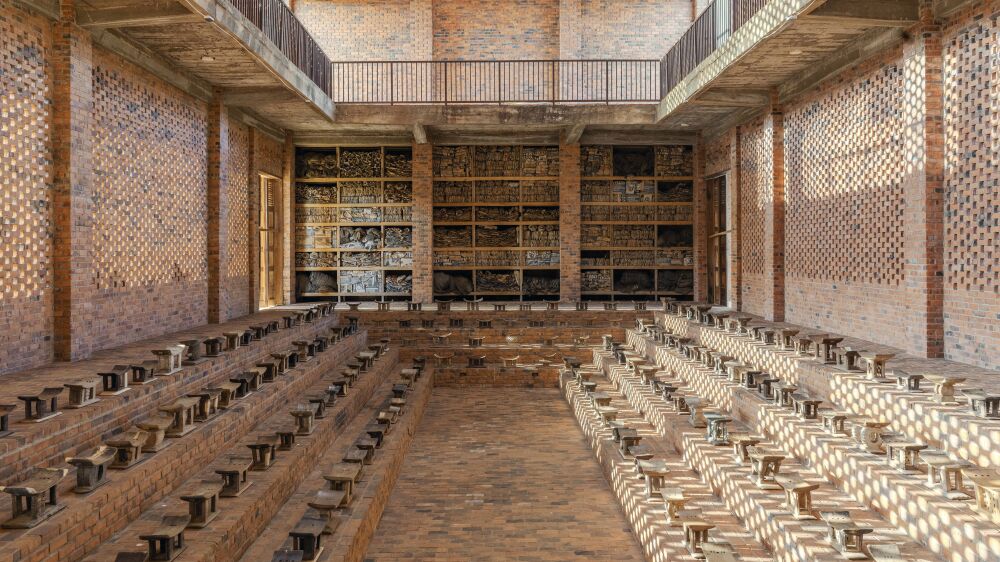
Since its creation, the Fondation Cartier has emerged as a place of dialogue, experimentation, and artistic exploration, open to emerging hubs of contemporary creation and the voices that comprise them. In the 1990s, it played a pioneering role in the presentation of artists from the African continent, such as Seydou Keïta, Bodys Isek Kingelez, Malick Sidibé, J. D. ’Okhai Ojeikere, and Chéri Samba. Following in these footsteps, The Harvest Season is Ibrahim Mahama’s first major exhibition in Paris, for which he has invited nine artists and collectives to join him.
Ibrahim Mahama (b. 1987 in Tamale, Ghana) has gained international recognition with installations made from collected materials, archives, and fragments of industrial heritage, which he reactivates to shape new imaginaries. Since the 2010s, he has developed a body of work that explores Ghana’s colonial and postcolonial legacies. Drawing on his country’s industrial and commercial history, he explores the circulation of goods, the transmission of craftsmanship and the preservation of heritage. His work also highlights political, social, and economic continuities and ruptures, with particular attention paid to infrastructure, traces of the past, and collective dynamics.
-

Red Clay, Tamale, 2025 -
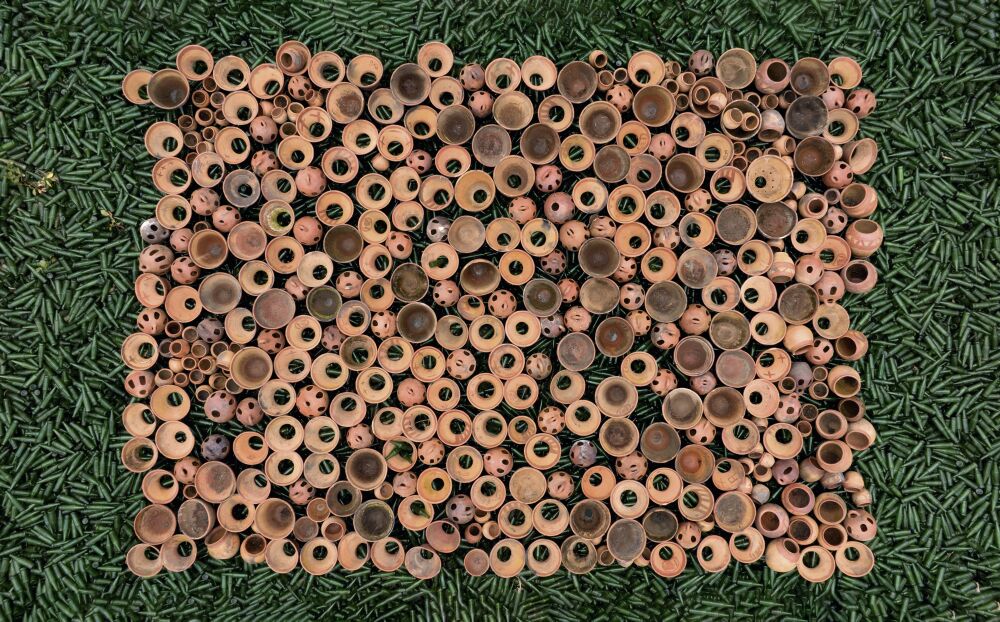
Ibrahim Mahama, Season of Migration to the North, 2025-2026, pots en terre cuite et bouteilles en verre, Red Clay, Tamale
Conceived by Ibrahim Mahama with nine artists and collectives, all of whom have long-standing ties to him through collaborations, research or exchanges, The Harvest Season is a natural continuation of such an approach. It references the three art centers established by the artist in Tamale, northern Ghana, from 2019 onward. Designed as spaces for creation and transmission, while being rooted in the local environment, these centers have contributed to the emergence of a network of independent cultural institutions on the African continent, where pedagogy plays a central role. Ibrahim Mahama’s centers engage in dialogue with other such initiatives across Africa. These include doual’art in Douala, Cameroon, founded in 1991 by Marilyn Douala Bell and Didier Schaub, which is considered a pioneer in the domain; the Centre for Contemporary Art Lagos (CCA) in Nigeria, opened in 2007 by Bisi Silva, RAW Material Company in Dakar, founded in 2008 by Koyo Kouoh, and more recently the Nairobi Contemporary Art Institute in Kenya, which was inaugurated in 2020 by Anglo-Kenyan artist Michael Armitage. All of these institutions have, each in their own way, invented new, sustainable models that engage and resonate with their environment. Echoing these initiatives, the exhibition takes an interest in the political, cultural, and social utopias formulated at the time of African independence in the 1950s and 1960s and seeks to reactivate these visions in order to question possible futures.
Associate artists and collectives
Photographer James Barnor (b. 1929 in Accra, Ghana) was a key witness to the fledgling Ghanaian nation at the time of its independence, mainly through his Ever Young studio in Accra, which profoundly marked the history of West African photography. His collaboration with Ibrahim Mahama in Tamale in 2024, focused on the Polaroid 20x24, continues this legacy and fosters an intergenerational dialogue based on transmission. For the exhibition, the public can see a collection of vintage prints and albums documenting the years following Ghana’s independence. James Barnor’s work as a portraitist and fashion photographer will also be shown in partnership with the RATP (Parisian public transport operator) at the galerie Valois, located in the Palais-Royal – Musée du Louvre metro station, for the duration of the exhibition.

Artist Dorothy Akpene Amenuke (b. 1968 in Adzokoe-Peki, Ghana) was the first female art professor at the Kwame Nkrumah University of Science and Technology (KNUST) in Kumasi, Ghana, where she taught Ibrahim Mahama. Since the 2000s, she has developed a body of textile work primarily using jute, which she transforms into monumental installations that explore material memory and artisanal gestures. For this exhibition, she is presenting works made from jute and handmade paper, as well as a large-scale installation that engages with and transforms the architecture of the Fondation Cartier.
Painter Gideon Appah (b. 1987 in Accra, Ghana), also studied at KNUST. Drawing on Ghana’s visual archives, mainly advertisements and press from the 1950s to the 1980s, he creates dreamlike compositions inhabited by fictional figures rooted in a historical reality. Displaying some thirty works, including one created specifically for the Fondation Cartier, this is the painter’s first exhibition of this scale in Europe.

Architect Courage Dzidula Kpodo (b. 1999 in Accra, Ghana) and the Postbox Ghana collective (comprising its founder, Manuela Nebuloni, born in 1986 in Milan, Italy, Nana Ofosu Adjei, b. 1993 in Accra, and Courage D. Kpodo) share Ibrahim Mahama’s interest in Ghanaian architectural history, as well as in the collection and promotion of archives related to the subject. Through the original use of archives and architectural heritage, they offer a fresh approach to Tropical Modernism. For the exhibition, the collective will present some one hundred postcards and stamps dating from the 1950s to the 1980s depicting emblematic Tropical Modernist architectural buildings and a range of Ghanaian urban landscapes. Courage Dzidula Kpodo also presents a partial reconstruction of a building from a Ghanaian cocoa plantation, at the intersection of visual art installation and architectural project.
German Ghanaian artist Zohra Opoku (b. 1976 in East Germany) has a German mother and Ghanaian father. She moved in Accra in 2011. She has developed a practice of screen printing onto textiles in which she explores how political, historical, cultural, and social contexts contribute to the construction of personal identity. Her approach puts textiles and traditional Ghanaian dress codes at its core. Making use of personal photographs, she screen prints these onto pre-dyed old fabrics, before embroidering and assembling them. The exhibition features a selection of older and more recent works on fabric, including some created for the Fondation Cartier’s exhibition spaces.

Founded in 2014 in the Democratic Republic of Congo, the Cercle d’Art des Travailleurs de Plantation Congolaise (CATPC) brings together artists and farm workers from oil palm and cocoa plantations. Deeming art to be a tool for economic and political liberation, the collective has financed, through the sale of its works, the purchase of agricultural land and the creation of an art center, known as the White Cube. In 2022, Ibrahim Mahama covered this with an installation of jute sacks. Here, the CATPC will present works created with products from the plantation: cocoa sculptures and embroideries on jute canvases resulting from the collaboration with Ibrahim Mahama.
Through personal narratives, Slovenian artist Tjaša Rener (b. 1986 in Slovenj Gradec, in former Yugoslavia, [now in Slovenia]) explores the historical relationships forged during the Cold War between Kwame Nkrumah’s Ghana—the country’s first president from 1960 to 1966—and Tito’s Yugoslavia, both founding nations of the Non-Aligned Movement. Her research and artistic work reveal how personal experiences and political legacies can merge within renewed forms of social connection, opening spaces for collective, transnational reflection. This research can be seen in installations combining reconstruction and archival material, as well as through a miniature art center, the Tiny Gallery, redolent of Ibrahim Mahama’s art centers.
Finally, Franco-Afghan artist, researcher, and architect Feda Wardak (b. 1991 in Peshawar, Pakistan) examines the consequences of extractivism and the infrastructure inherited from colonial periods, particularly in terms of the access of rural populations to water. Like Ibrahim Mahama, whom he has met on several occasions at various exhibitions, Wardak uses architecture as a poetic, political, and collaborative tool, developing a reflection on collective memory and traditional artisanal expertise. In addition to an architectural installation designed for exhibition at the Fondation Cartier, he will present a film and a collection of archival material documenting his collaboration with diggers of underground water supply tunnels in the agricultural regions of eastern Afghanistan.
The Harvest Season suggests the gentle cycle of creation: from the sowing of ideas to the transmission of expertise through to harvesting the fruits of a collective engagement, all within a logic where history can feed the futures yet to be invented.
Curators
Exhibition curators:
Aby Gaye-Duparc (Ibrahim Mahama)
Jeanne Barral (Associate artists)
Associate curator:
Chiara Agradi (James Barnor)
Events
-

- Paris
Raymond Hains: A Work Under Construction. From the Grand Louvre to the 3 Cartier
Place du Palais-Royal
- Tue 09 Jun → Sun 23 Aug 2026
- Place du Palais-Royal
-

- Paris
- Tue 09 Jun → Sun 04 Oct 2026
- Galerie Valois

Change language
- English
- Français
- Arabic أهلًا بك في مؤسّسة Fondation Cartier pour l’art contemporain
- Deutsch Willkommen bei der Fondation Cartier pour l’art contemporain
- Español Bienvenida a la Fondation Cartier pour l’art contemporain
- Italiano Ti diamo il benvenuto alla Fondation Cartier pour l’art contemporain
- Japanese Fondation Cartier pour l’art contemporain へようこそ
- Chinese 欢迎来到Fondation Cartier pour l’art contemporain
- Korean Fondation Cartier pour l’art contemporain에 오신 것을 환영합니다