Andrea Branzi by Toyo Ito
Continuous Present
- Exhibition, Milan
- Thu 19 Mar → Sun 04 Oct 2026
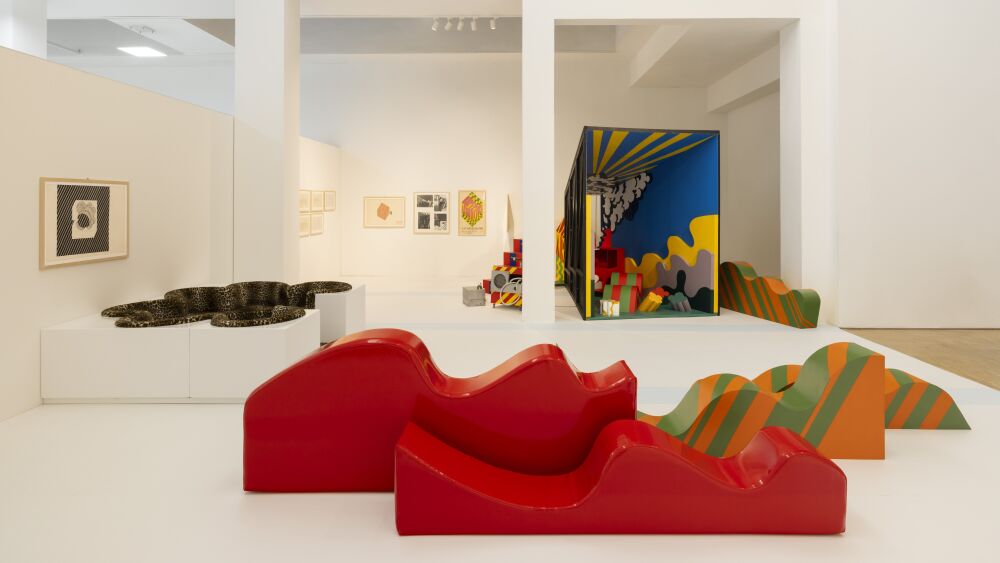
As part of their cultural partnership, from March 19 to October 4, 2026, Triennale Milano and Fondation Cartier pour l’art contemporain are presenting a large monographic exhibition dedicated to Andrea Branzi – an architect, designer, professor, curator and artist, recognized as one of the leading contemporary figures in Italian design and design philosophy – portrayed through the eyes of the Pritzker award-winning Japanese architect Toyo Ito, Branzi's co-author of many projects and longtime friend.
This exhibition Andrea Branzi by Toyo Ito: Continuous Present is an homage that arises from the close bond that the two cultural institutions maintained with Andrea Branzi: on one side there was his collaboration with Triennale Milano as a designer, theoretician and curator, that took shape in numerous initiatives carried out from 1968 until 2022; on the other was the reflections that led him to conceive the two environments originally presented in the Open Enclosures exhibition, staged at the Fondation Cartier in 2008, and since then belonging to its collection, a unique example of porousness between landscape, architecture, art and design.
Conceived by Toyo Ito, in collaboration with Lorenza Branzi and Nicoletta Morozzi, and curated by Nina Bassoli, curator for architecture, urban regeneration and cities at Triennale, and Michela Alessandrini, curator at Fondation Cartier, the exhibition is a biographical itinerary – from Branzi’s first radical experimentations in Florence with Archizoom Associati, through his experiences with Alchimia and Memphis, up to the development of an anthropological approach to design – highlighting Branzi’s constant research into the topics of fragility, hybridization, coexistence, ecology, and the cross-fertilization between disciplines.

Toyo Ito shapes the exhibition design as “the unceasing flow”, based on the idea of a fluid itinerary that can highlight how the pieces presented in the exhibition and Andrea Branzi’s philosophy exist neither in the past nor in the future, but in a “continuous present”. It offers the public the experience of a living and evolving practice, within a space by “flow and eddies”.
Over 400 works are on display in the exhibition, including environmental installations, models and designs, small and large scale objects from well-known and less familiar product ranges, as well as archive videos and documents. The exhibition opens and closes with two self-portraits, and includes a large site-specific installation dedicated to No-Stop City (1969–72), the foundational project that crystallized Branzi’s idea of “the writing of territory” and represents a radical critique of the modern metropolis; there is also a journey through the numerous subsequent experiments in architectural, landscape, and urban design, culminating in a series of display screens dedicated to theoretical metropolises.
Exhibition itinerary
The exhibition itinerary is set out in a thematic archipelago composed of 11 sections, in a fluid space that fosters organic, mutable and incessantly renewed similarities between the works. The exhibition path leads through the reproduction of Superarchitettura (Superarchitecture) – the first exhibition of Archizoom in 1966 – and the first furniture and design ranges, with a special in-depth exploration dedicated to No-Stop City; it continues through a broad selection of territory projects in Metropoli teoriche (Theoretical metropolises), and the experimentations with materials carried out during the 1970s, brought together in Decorattivo (Decoractive).
-

Andrea Branzi par Toyo Ito, Continuous Present, Triennale Milano Photo © Andrea Rossetti -

The Superfici Attive (Active Surfaces) section presents a series of landscape projects, while some interior design projects and furnishings can be seen inside the Case a pianta centrale (Houses with a central plan), including the famous Animali Domestici (Domestic Animals) series. At the core of the exhibition the two Open Enclosures environmental installations Ellipse and Gazebo are reactivated, anticipating the monumental installation Record e Paradiso and other items of the section they belong to, Ambienti e dispositivi espositivi (Environments and exhibition devices), which is focused on the role of displaying and composing in Branzi’s aesthetical and spatial vision of the world.
The Japanese projects can be found in La civiltà dell’ascolto (The civilization of listening) section, close to Musei, piazze, mostre, palchi (Museums, Piazzas, exhibitions and stages), an exploration of his curatorial and museographic as well as concerning public place and theatre’s staging projects.
Coming towards the end of the show, we find themed islands of objects and anthropologic designs dedicated to Ospitalità cosmica (Cosmic Hospitality) on interspecies cohabitation and collaboration; and Oggetto Ibrido (Hybrid object), where Branzi’s design brakes barriers by experimenting with grafts.
Last but not least, halfway through the path imagined by the curators, one can find a space dedicated to publications and unreleased videos interviews by Hans Ulrich Obrist, a way to foster education and transmission as a solid value in Branzi’s practice.
The exhibition is accompanied by a public program of events, which will take place between April and October 2026 and will start with a lecture by Toyo Ito on Monday April 20 at 11.00, organized for the occasion of Milan Design Week.


A book is co published by Electa, Triennale Milano and the Fondation Cartier in conjunction with the exhibition. Available in Italian and English, it explores Andrea Branzi’s principal lines of thought in a series of thematic essays and brings together over 50 contributions from authors, designers and international artists who were each invited to describe the influence of a seminal work by Andrea Branzi on their own work and on contemporary design culture by addressing selected projects.
The text is accompanied by a large selection of previously unpublished images, photos, drawings and archival documents.
Triennale Milano Institutional Partners’ Deloitte and Fondazione Deloitte, Lavazza Group and Salone del Mobile.Milano are supporting Triennale Milano with this exhibition. Triennale Milano also thanks Rotaliana for its support in the exhibition setup.
A production by: Triennale Milano and Fondation Cartier pour l’art contemporain
In collaboration with: Lorenza Branzi and Nicoletta Morozzi
Concept and exhibition design: Toyo Ito & Associates, Architects
Curated by: Nina Bassoli and Michela Alessandrini

Modern, Postmodern, Millenary
A text by Andrea Branzi
Events
-

- Tue 28 Jul 2026, 19:00
- Fondation Cartier pour l’art contemporain
-

- Paris
Raymond Hains: A Work Under Construction. From the Grand Louvre to the 3 Cartier
Place du Palais-Royal
- Tue 09 Jun → Mon 26 Oct 2026
- Place du Palais-Royal

Change language
- English
- Français
- Arabic أهلًا بك في مؤسّسة Fondation Cartier pour l’art contemporain
- Deutsch Willkommen bei der Fondation Cartier pour l’art contemporain
- Español Bienvenida a la Fondation Cartier pour l’art contemporain
- Italiano Ti diamo il benvenuto alla Fondation Cartier pour l’art contemporain
- Japanese Fondation Cartier pour l’art contemporain へようこそ
- Chinese 欢迎来到Fondation Cartier pour l’art contemporain
- Korean Fondation Cartier pour l’art contemporain에 오신 것을 환영합니다