Le Temps de la parole, around the exhibition (cancelled)
- Events, Paris
- Sat 24 Oct 2026, 11:00 → 18:30

Location
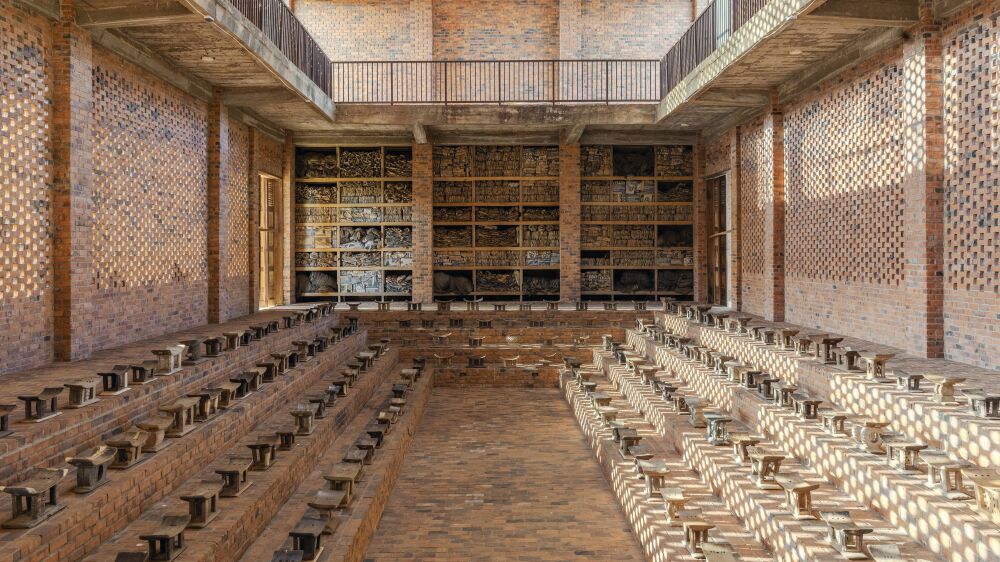
Parliament of Ghosts
Fondation Cartier pour l'art contemporain
2, Place du Palais-Royal
The Temps de la parole invite visitors to take a seat within the Parliament of Ghosts installation, designed as a space for exchange and an agora. These gatherings bring together the artists of the exhibition as well as guest artists in dialogue with Ibrahim Mahama’s practice, art schools, and partner institutions.
On Saturday, October 24, a day of talks will bring the artists of The Harvest Season into dialogue with thinkers, researchers, architects, and artists. Drawing from the works in the exhibition and the history of the Parliament of Ghosts, this program aims to explore key themes of the project through cross-disciplinary exchanges.
Programme
11:30am: Keynote by Ibrahim Mahama
12am: Museums, Restitutions, and the Future of Colonial Collections
Bénédicte Savoy, art historian and professor
Anne Lafont, art historian and professor
Ibrahim Mahama, artist of the exhibition
Ced’art Tamasala, artist of the exhibition and CATPC member
Moderation : Aby Gaye-Duparc
1pm: Photographing Ghana’s Independence
James Barnor, photographer and artist of the exhibition
Damarice Amao, curator at the Photography Department, MNAM-Centre Pompidou
Moderation : Chiara Agradi
2:30pm: Land, Plantations, and Extractive Industries
Agata Nguyen Chuong, architect, Forensic Architecture
Feda Wardak, architect and artist of the exhibition
Ced’art Tamasala, artist of the exhibition and CATPC member
Moderation : Jeanne Barral
3:30pm: Transnational Solidarity and the Legacy of the Non-Aligned Movement
Tjaša Rener, artist of the exhibition
Zola Chichmintseva-Kondamambou, curator and cultural worker
Zohra Opoku, artist of the exhibition
Moderation : Aby Gaye-Duparc
4:30pm: Textiles, Craftsmanship, and Passing Down Traditions
N’Goné Fall, exhibition curator
Dorothy Amenuke, artist of the exhibition
Bernard Akoi-Jackson, artist and professor at the Kwame Nkrumah University of Science and Technology (KNUST)
Zohra Opoku, artist of the exhibition
Moderation : Jeanne Barral
5:30pm: Building Differently, Architecture and the Postcolonial Context
Meriem Chabani, architect and founder of the NEW SOUTH agency, Paris
Courage Dzidula Kpodo, architect and artist of the exhibition
Feda Wardak, architect and artist of the exhibition
Moderation : Aby Gaye-Duparc
Biographies
Bernard Akoi-Jackson
Bernard Akoi-Jackson is a Ghanaian artist, curator, writer, and lecturer living and working between Accra, Tema, and Kumasi, in Ghana. He holds a PhD in Painting and Sculpture from the Kwame Nkrumah University of Science and Technology (KNUST), in Kumasi, where he also lectures. His research and teaching focus on disruption, performativity, and the revolutionary potential in contemporary art practice. His practice as an artist is multidisciplinary and audience-implicating, spanning painting, sculpture, installation, performance, photography, video, text, poetry, and dance. Through performative “pseudo-rituals” and immersive installations, he examines postcolonial African identities, with particular attention to bureaucratic procedures and colonial remnants that generate absurd, stalled, or circular situations.
Dorothy Akpene Amenuke
Born in 1968 in Ghana, Dorothy Akpene Amenuke lives and works in Kumasi, where she has been teaching at the Kwame Nkrumah University of Science and Technology (KNUST) since 2009. She was the first female professor at the Department of Painting and Sculpture. Driven by a commitment to the community centered on care, sharing, and transmission, she involves family members, students, and peers in the conception and creation of her artworks. Since the 1990s, Dorothy A. Amenuke’s work can be said to represent a break from the academic heritage she received and offer a renewal of the sculptural vocabulary. Drawing inspiration from the materials of her everyday environment—patchwork blankets, pandanus mats, plastic bags—she sees textiles as a sculptural material in their own right, which she shapes like clay or wood.

Damarice Amao
Damarice Amao holds a PhD in Art History. Her expertise focuses on modern French and European photography from the interwar period. She curated the exhibition Unframing Colonialism (2022) at the Centre Pompidou and co-curated Dora Maar (2019) and Photography as a Weapon of Class (2018). She recently curated Ghana! Dreaming Independence, 1957-1976 (2026) for the Rencontres d’Arles. She contributes to numerous publications and exhibition catalogues, including recent works on Wolfgang Tillmans (2025) and Lisette Model (2025). She is a curator in the photography department of the MNAM-Centre Pompidou.
James Barnor
James Barnor’s work (born 1929, Ghana) spans over seven decades, crosses continents and encompasses a range of photographic genres, from studio portraiture to outdoor photography. Considered a pioneer of African photography, he founded the Ever Young studio in Accra in 1953, a key place for Ghanaian society on the road to independence. In 1959, after documenting the independence of Ghana, James Barnor moved to London to improve his technical skills. He captured the vibrant energy of the capital in the 1960s. In the late 1960s, he returned to Ghana to open the country’s first color photography laboratory. Now 97 years old, James Barnor lives in London, where he devotes his time to the organization of his photographic archive and has a desire to pass on Ghanaian cultural and industrial heritage to younger generations.

Meriem Chabani
Born in Algiers and based in Paris, Meriem Chabani is an architect and the founder of the firm NEW SOUTH. Operating at the intersection of architectural practice and research, she advocates for a decolonial approach to architecture. She is currently a finalist for the National Slavery Museum in Amsterdam. A frequent award recipient, she won the Europe 40 Under 40 award in 2020. In 2023, AMC recognized her as one of the profession’s emerging female figures. In 2025, Le Monde named her as a key figure to watch in the cultural sphere.

Zola Chichmintseva-Kondamambou
Zola Chichmintseva-Kondamambou is a curator and cultural mediator working at the intersection of Afro-diasporic cultures and so-called post-socialist and "post-Soviet" spaces, dissecting the (de)colonial gaze regarding cultures, memories, and languages. Her transdisciplinary approaches and projects take the form of intellectual debates and exchanges, the archiving of oral histories, and exhibitions. Zola’s work draws on colonial histories, their dissemination and implications, to interrogate contemporary political and cultural realities. A graduate of Sorbonne Nouvelle-Paris 3 and Sciences Po Strasbourg, Zola has collaborated with Manifesta (the European Nomadic Biennial), the Fondation pour la mémoire de l’esclavage, the Maison de la Culture d’Amiens, La Gaîté Lyrique, and the MansA—Maison des Mondes Africains.

N’Goné Fall
N’Goné Fall is an exhibition curator and specialist in cultural engineering. As the editorial director of Revue Noire magazine (1994 – 2001), she has developed exhibitions in Africa, Europe, and the United States. She has authored strategic plans for national and international institutions and taught at Senghor University in Alexandria, the Michaelis School of Fine Art in Cape Town, and Abdou Moumouni University in Niamey. She served as General Commissioner for the Africa2020 Season, a series of over 1 500 cultural, scientific, and educational events held in France from December 2020 to September 2021.
Courage Dzidula Kpodo
Born in 1999 in Accra, Ghana, Courage Dzidula Kpodo is an architect and artist. He studied at the Department of Architecture at the Kwame Nkrumah University of Science and Technology (KNUST) in Kumasi, Ghana, and at the Massachusetts Institute of Technology (MIT) in the United States. In his practice, Courage D. Kpodo takes on the role of an archeologist of 20th-century material heritage, particularly of the architectural movement known as Tropical Modernism, which developed in West Africa following independence and then evolved thanks to local architects who adapted Modernist principles to the tropical context. Courage D. Kpodo has fashioned a critical reflection around this movement. Here, Courage D. Kpodo takes a step away from the monumental buildings traditionally depicted in archives to celebrate vernacular architecture.

Anne Lafont
Anne Lafont is an art historian and Director of Studies at the EHESS. Her work focuses on art within the Black Atlantic. In 2019, she published the book L’art et la Race. L’Africain (tout) contre l’œil des Lumières and contributed to the exhibition Black models: from Géricault to Matisse at the Musée d'Orsay. She co-edited the book L’Afrique et le monde. Histoires renouées (2022) with François-Xavier Fauvelle. Her latest book, published in Brazil, is titled A Arte dos mundos negros: história, teoria, crítica (2023).

Ibrahim Mahama
Born in 1987 in Tamale, Ghana, Ibrahim Mahama creates works from collected materials, archives, and fragments of Ghana’s industrial heritage. Jute, emblematic of his work, is used here as a scenographic element in the exhibition. His textile works are made from jute sacks once used to transport cocoa and charcoal. These recovered materials preserve the traces of a history marked by manual labor and international economic exchange. From 2006 onwards, he studied at the Kwame Nkrumah University of Science and Technology (KNUST) in Kumasi, Ghana, where he developed his unique practice of collecting and assembling raw materials, giving rise to monumental installations that unfold in public spaces and question the memory of his country. He founded the Savannah Centre for Contemporary Art (2019), Red Clay (2020), and Nkrumah Voli-ni (2022) in Tamale, three art centers dedicated to creation and heritage preservation.

Agata Nguyen Chuong
Agata Nguyễn Chương is a senior researcher at Forensic Architecture and PhD student in the Centre for Research Architecture at Goldsmiths, University of London. Agata leads FA’s research on the Ovaherero and Nama genocide in present-day Namibia, focusing on evidencing the legacies of environmental and colonial violence and developing methodologies in support of Indigenous claims and advocacy. Her PhD project develops the notion of the ‘ecocide continuum’ in Vietnam.
Zohra Opoku
Born in 1976 in the former German Democratic Republic (GDR), Zohra Opoku is a German-Ghanaian artist. Her work examines how political, historical, cultural, and social contexts influence the construction of individual identities. The artist’s parents met in 1975 at a university near Leipzig, in East Germany, as part of a student exchange program implemented by Kwame Nkrumah. A few months after Zohra Opoku’s birth, her father returned to Ghana, and she was raised by her maternal family. In her artistic work, Zohra Opoku reinterprets beads, ceremonial fabrics, and photographs inherited from her father. She screenprints these photographs onto antique fabrics before embroidering and assembling them. Her works draw inspiration from the various stages of her life: childhood memories, the experience of motherhood, the exploration of her African identity, and the ordeal of illness.
Tjaša Rener
Born in 1986 in the former Yugoslavia, Tjaša Rener moved to Ghana in 2013, settling in a village on the shores of Lake Bosumtwi, before moving to the capital Accra in 2016. Her work explores how personal narratives and political legacies can intertwine, opening spaces for collective and transnational reflection. In 2022, she created a miniature gallery outside her studio in a working-class neighborhood of Accra, offering passersby and locals a program of exhibitions on a small-scale format. In 2023, she participated in the Ljubljana Biennale of Graphic Arts in Slovenia and presented the installation Place We Call Home (2023). In the installation Between Arrival and Belonging (2026), Tjaša Rener brings together documents and photographs showcasing the political and emotional migrations of the non-aligned countries.
Bénédicte Savoy
Bénédicte Savoy, an alumna of the École normale supérieure, has been a professor of art history at the Technical University of Berlin since 2009, where she holds a chair dedicated to "Art History as Cultural History." She is the author of numerous works focusing on the cultural and social history of the arts, the history of museums, and issues surrounding the spoliation of art. In 2018, she co-authored Restituer le patrimoine africain (Le Seuil/Philippe Rey, 2018) with Felwine Sarr. Bénédicte Savoy is a member of the Berlin Academy of Sciences. In 2016, she was awarded the Gottfried Wilhelm Leibniz Prize by the Deutsche Forschungsgemeinschaft.
Ced’art Tamasala
Ced’art Tamasala is a member of the Cercle d’Art des Travailleurs de Plantation Congolaise (CATPC). Founded in 2014 in the Democratic Republic of Congo, the CATPC brings together artists and farm workers from oil palm and cocoa plantations. Deeming art to be a tool for economic and political liberation, the collective has financed, through the sale of its works, the purchase of agricultural land and the creation of an art center, known as the White Cube. In 2022, Ibrahim Mahama covered this with an installation of jute sacks. Here, the CATPC will present works created with products from the plantation: cocoa sculptures and embroideries on jute canvases resulting from the collaboration with Ibrahim Mahama.
Feda Wardak
Born in 1991 in Peshawar, Pakistan, Franco-Afghan architect and artist Feda Wardak examines the effects of extractivism and imperialist legacies on inhabited environments. Since 2012, he has explored the effects of armed conflict on traditional water management systems in rural areas such as Jaghatu, eastern Afghanistan. In these territories where water governs both planting times and social organization, Feda Wardak has given himself the objective of collectively repairing karez, millennia-old underground irrigation networks. This commitment is also expressed through his artworks, like the Chercheurs d’eau (Water Seekers) series begun in 2024. Feda Wardak sees architecture as a tool that is political and collective alike, using visual, choreographic, cinematic, and sound forms to engage in repair, preservation, and the duty of remembrance.
Events
-

- Paris
nora chipaumire
Gadzi, A Paris Chapter
- Thu 17 Dec → Sat 19 Dec 2026, 21:00
- Parliament of Ghosts
As part of the 2026 Festival d’Automne in Paris
-

- Paris
Seeing Sounds
Awesome Tapes From Africa
- Thu 12 Nov 2026, 19:00 → 20:30
- Studio Marie-Claude Beaud
-

- Paris
Julianknxx
Listening in Quantum Act II
- Wed 24 Feb → Thu 25 Feb 2027, 21:00
- Parliament of Ghosts
Change language
- Français
- English
- العربي أهلًا بك في مؤسّسة Fondation Cartier pour l’art contemporain
- Deutsch Willkommen bei der Fondation Cartier pour l’art contemporain
- Español Bienvenida a la Fondation Cartier pour l’art contemporain
- Italiano Ti diamo il benvenuto alla Fondation Cartier pour l’art contemporain
- 日本語 Fondation Cartier pour l’art contemporain へようこそ
- 中文 欢迎来到Fondation Cartier pour l’art contemporain
- 한국어 Fondation Cartier pour l’art contemporain에 오신 것을 환영합니다