

Born 1932, Bogota (Colombia)

Olga de Amaral is an iconic figure on the Colombian art scene and one of the most important textile artists of her generation.
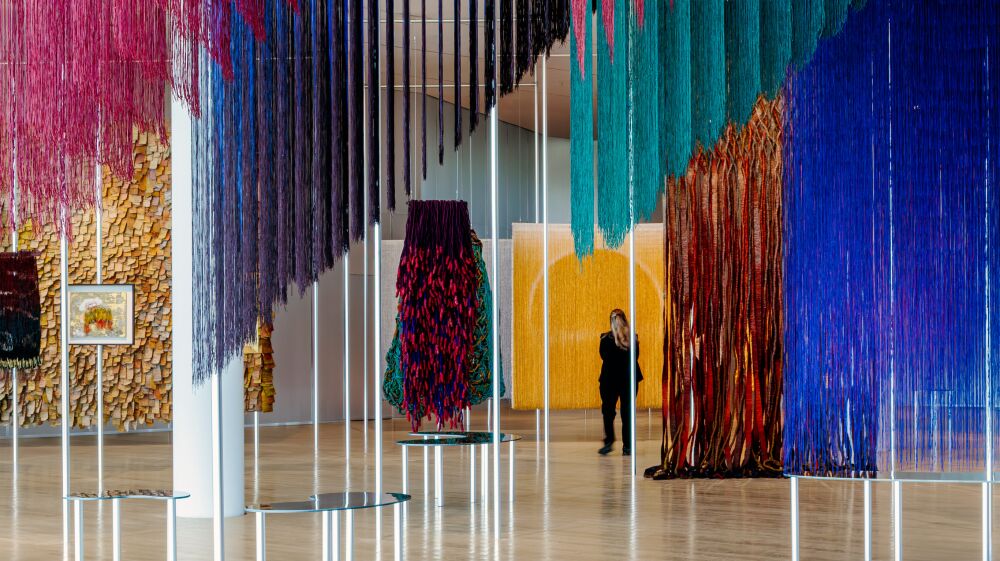
De Amaral's was first presented at the Fondation Cartier in the exhibition Southern Geometries, from Mexico to Patagonia (2018–2019). Five years later, in October 2024, the foundation inaugurated the artist's first comprehensive retrospective in Europe in spaces designed by architect Lina Ghotmeh. The exhibition brought together around eighty works created from the 1960s to the present day, many of which had never been shown outside Colombia. In addition to her vibrant creations in gold leaf, for which the artist is famous, the exhibition revealed her first explorations and experiments in textile works, along with her monumental pieces. The retrospective clearly showed de Amaral's fundamental contribution to the artistic avant-garde of the 1960s, 1970s, and 1980s.


After obtaining a diploma in architecture from the Colegio Mayor de Cundinamarca (1951–1952), she pursued her studies at the Cranbrook Academy of Art in Michigan, USA (1954–1955). She was exposed to the Bauhaus school, where she discovered textile art in the weaving atelier of Marianne Strengell, a Finnish-American artist and designer. In the 1960s and 1970s, de Amaral joined with Sheila Hicks and Magdalena Abakanowicz to develop the Fiber Art movement, using new materials and techniques inspired both by modernist principles and the indigenous traditions of her own country. Her monumental abstract works free themselves from walls and refuse any attempts to categorise them. Simultaneously reminiscent of painting, sculpture, installation work and architecture, they envelop their viewers in the intimate sensory world of the artist. De Amaral was named a Visionary Artist by the Museum of Arts & Design in New York in 2005, and received the Women’s Caucus for Art Lifetime Achievement Award in 2019. Her works are featured in prominent public and private collections throughout the world, notably the Tate Modern, MoMA, the Musée d’Art Moderne de Paris and the Art Institute of Chicago. The Houston Museum of Fine Arts dedicated a major exhibition to her oeuvre in 2021, entitled To Weave a Rock.