Le Temps de la parole with MansA
Maison des Mondes Africains
- Events, Paris
- Fri 20 Nov 2026, 19:00 → 20:30
- Accessible with your exhibition ticket


Location
Parliament of Ghosts
Fondation Cartier pour l'art contemporain
2, Place du Palais-Royal
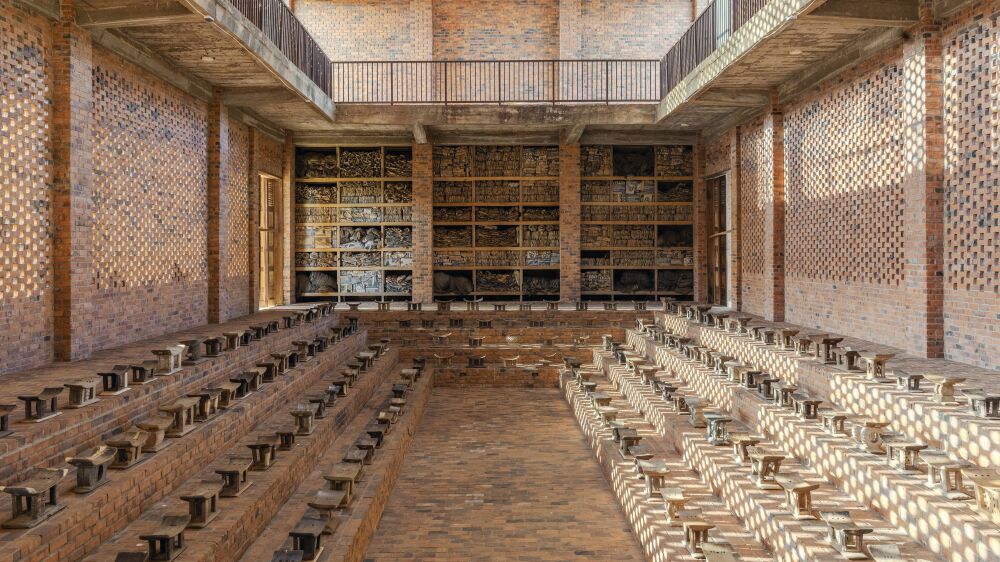
The Temps de la parole invite visitors to take a seat within the Parliament of Ghosts installation, designed as a space for exchange and an agora. These gatherings bring together the artists of the exhibition as well as guest artists in dialogue with Ibrahim Mahama’s practice, art schools, and partner institutions.
For one evening, scholar and visual artist Mame-Fatou Niang brings together Assa Diallo-Doucouré, a student from Seine-Saint-Denis, Olivette Otele, Mohamed Mbougar Sarr, and Zana Masombuka around Neoblast, a performance reading about emergence.
Neoblasts are the cells responsible for regeneration. It is also the name of a decade-long project that, over the course of a decade, has collected the voices of women from Dakar to Berlin, by way of Clichy-Montfermeil and Rio de Janeiro. The evening will open with the story of a shipwreck, told from the abyss by a drowned woman. Neither entirely dead nor still alive, she will turn to the audience with a question: should she return to a world in which she remains invisible? The voices of Olivette Otele, Mohamed Mbougar Sarr, and Masombuka will accompany her ascent, inviting her to choose emergence and affirm her presence. Born in Clichy-Montfermeil, Assa Diallo-Doucouré will bring this chorus to a close, carrying the voice of a generation that no longer merely asks to be seen, but affirms its presence.
Set within the Parliament of Ghosts, this carte blanche brings the living into conversation with the invisible and with those whose voices are still trying to reach us. It asks: what becomes of a place when those who are not expected there decide to take their place?
This event is part of N.A.R.D.A.L. (Nouvelle Approche de Recherche sur les Dynamiques Afro-descendantes en Liaison), a programme led by MansA that launches each season with "cartes noires"—curatorial residencies entrusted to iconic African or Afro-descendant women.
Readings and a discussion featuring Mohamed Mbougar Sarr, Olivette Otélé, Mame-Fatou Niang, Zana Masombuka, and Assadiallo Doucouré.

Olivette Otélé
Olivette Otele is a world-renowned historian, author of African Europeans: An Untold History (2020) and was the first Black woman to be appointed to a professorial chair in History in the UK. She joined SOAS University of London as a Distinguished Research Professor of the Legacies and Memory of Slavery within the Faculty of Law in 2022. She was a judge and chair for several book prizes (International Booker Prize, Orwell Prize, etc.) and a Visiting Chair at the College de France (2023). Professor Otele has published extensively on Colonial History and Memory, the histories of people of African descent and restorative justice. She also advises several governments and institutions on the matter. Her latest publications include 'Comparative Focus on Legacies of Enslavement in the United Kingdom and France' (OUP, 2026) and she is currently editing her monograph on 15 port cities that made empires through slavery (2027).

Mohamed Mbougar
Mohamed Mbougar Sarr is a Senegalese novelist, born in Dakar, in 1990. He studied literature and philosophy at the School for Advanced Studies in Social Sciences (EHESS) in Paris. In 2021, Sarr received France’s oldest and most prestigious literary prize, the Prix Goncourt, for his fourth novel The Most Secret Memory Of Men, becoming the first writer from sub-Saharan Africa to win the prize. In this gripping literary mystery and coming-of-age novel, Sarr unravels the fascinating life of a maligned Black author, based on Yambo Ouologuem. His work is haunted by absent figures and forgotten histories whose voices continue to reach, disturb, and transform the living.

Mame-Fatou Niang
Mame-Fatou Niang is Trustee Professor of French Studies and the Founder-Director of the Center for Black European Studies and the Atlantic at Carnegie Mellon University. She is the author of Identités Françaises (Brill, 2019) and the co-author of Universalisme (Anamosa, 2022). Her recent research examines Black geographies, Blackness in France and the institutionalization of Black Studies Niang is the international curator of the Rio de Janeiro Literary Festival (FLUP), and an artist-in-residence at Ateliers Médicis in Paris, and a fellow at the French Academy in Rome, Villa Medici working on a project entitled “Échoïques” (Sounds of Silence). She is a member of the Black|France|Noire collective and the co-founder of G-SAP, the Global Network for the Studies of Africans and People of African Descent. Mame has held prestigious visiting professorships such as the Melodia Jones Distinguished Chair of French Studies at University at Buffalo, and a Distinguished Visiting Professor in French Studies at Columbia University. She is currently completing two books: a study of Alice Diop and the first French translation of Beatriz Nascimento’s work.

Zana Masombuka
Zana Masombuka, known as the ‘Ndebele Superhero,’ is a South African visual artist based between Johannesburg and her farm in Sterkloop, Mpumalanga. She works across photography, film, sculpture, and performance to explore modernity and our engagement with spirits. Growing up in Siyabuswa, KwaNdebele, she draws on her heritage to create visual narratives with global relevance. A graduate of Stellenbosch University in international studies, Masombuka’s work emphasizes the self-reinvention of African identity. Her platform, ‘Ndebele Superhero,’ reflects the evolving Ndebele culture and the interplay of tradition and modernity. In her solo exhibition Nges’rhodlweni: A Portal for Black Joy at October Gallery, Masombuka celebrated the role of communal spaces in preserving and transmitting cultural knowledge.

Assadiallo Doucouré
Assadiallo Doucouré defines herself as a Black, Muslim, French, Malian, Soninke and Suburban woman from the poor suburbs known as “banlieues”. She grew up in Clichy-sous-Bois and occupies the 7th place of 9 children, earning her the nickname “Dado”. She is trained as a sociologist, however she took a break from her professional career to “restore, repair and heal her wounds caused by the violence of work and of these worlds”. She took part in the “Echoïques” art project, directed by Mame-Fatou Niang, whose aim was to explore the role of sounds, noises, and silences in the creation of memory fabrics. She is co-president of a feminist and anti-racist association, Lallab, whose aim is to make the voices of Muslim women heard and to defend their rights.


Events
-

- Paris
Le Joyeux Week-end
Your joyful and festive gathering for families at the Fondation Cartier
- Sat 07 Nov → Sun 08 Nov 2026
- Fondation Cartier pour l’art contemporain
For families, ages 3 to 12
-

- Sun 25 Oct 2026, 17:00 → 18:00
- Parliament of Ghosts
-
- Sat 24 Oct 2026, 11:00 → 18:30
- Parliament of Ghosts
Change language
- Français
- English
- العربي أهلًا بك في مؤسّسة Fondation Cartier pour l’art contemporain
- Deutsch Willkommen bei der Fondation Cartier pour l’art contemporain
- Español Bienvenida a la Fondation Cartier pour l’art contemporain
- Italiano Ti diamo il benvenuto alla Fondation Cartier pour l’art contemporain
- 日本語 Fondation Cartier pour l’art contemporain へようこそ
- 中文 欢迎来到Fondation Cartier pour l’art contemporain
- 한국어 Fondation Cartier pour l’art contemporain에 오신 것을 환영합니다